




 Researcher at the Institute of Archaeology of the RAS Irina Reshetova. Ekaterina Lameykina –
The discovery was made by an international underwater archaeological expedition earlier this year. The expedition, conducted in shallow waters at depths of about 1 to 4 m (3.3 to 13 ft) , uncovered submerged ruins including brick buildings, a millstone, decorated architectural fragments, a 13th–14th-century Muslim necropolis, burials, and large ceramic vessels. It confirms that a thriving settlement once stood there before being lost to an earthquake.
The importance of the Issyk-Kul discovery lies in confirming the existence of a medieval Silk Road city long thought lost, offering direct evidence of its architecture, trade, and religious life. By uncovering ruins, artifacts, and burials, scientists can now reconstruct how different cultures, economies, and faiths intersected in Central Asia, while also preserving a unique underwater heritage site that had remained hidden for centuries.
The first site discovered by scientists during the Issyk-Kul expedition was the ruins of a medieval city. At this site, they found baked-brick buildings, fragments of destroyed structures, and a stone millstone used for grinding grain. They also discovered an architectural feature that suggests a decorated social building like a mosque, bathhouse, or madrasa. They recorded the remains of stone and wooden-beam structures, and then sent samples for dating to find out the settlement’s age.
“The monument under study is a city or a large commercial agglomeration on one of the important sections of the Silk Road,” explained Valery Kolchenko, who led the Kyrgyz team. “At the beginning of the 15th century, as a result of a terrible earthquake, the city went under the waters of the lake.”
Kolchenko likens the drama of the earthquake to the volcanic decimation of Pompeii. He suggests the city was quickly flooded.
The team also collected fragments of wood and other organic materials from the structures and sent them for dendrochronological analysis (studying tree-ring patterns to determine age) and AMS dating (Accelerator Mass Spectrometry, an exact form of radiocarbon dating).
The second site revealed a striking and haunting discovery: a Muslim cemetery from the 13th to 14th century beneath the lake’s waters. It covers an area measuring about 300 x 200 m (984 x 656 ft).
Archaeologists documented burials that followed traditional Islamic rituals; skeletons were laid with their bodies facing north and their faces turned toward the Qibla, the direction of the Kaaba in Mecca.
From this necropolis, the team recovered the remains of two individuals, a man and a woman. They will undergo in-depth anthropological study to better understand their age, health, and cultural context. The site provides direct evidence of how Islamic practices spread into Central Asia during the Silk Road era.
“People here practiced various religions: pagan Tengrianism, Buddhism, Nestorian Christianity,” said Maksim Menshikov, a researcher working on the expedition. “The ruling elite often turned to Islam during their rule, but this religion did not become widespread in Central Asia until the 13th century. Before that, Islam was primarily the religion of the nobility and of those engaged in active economic activity.”
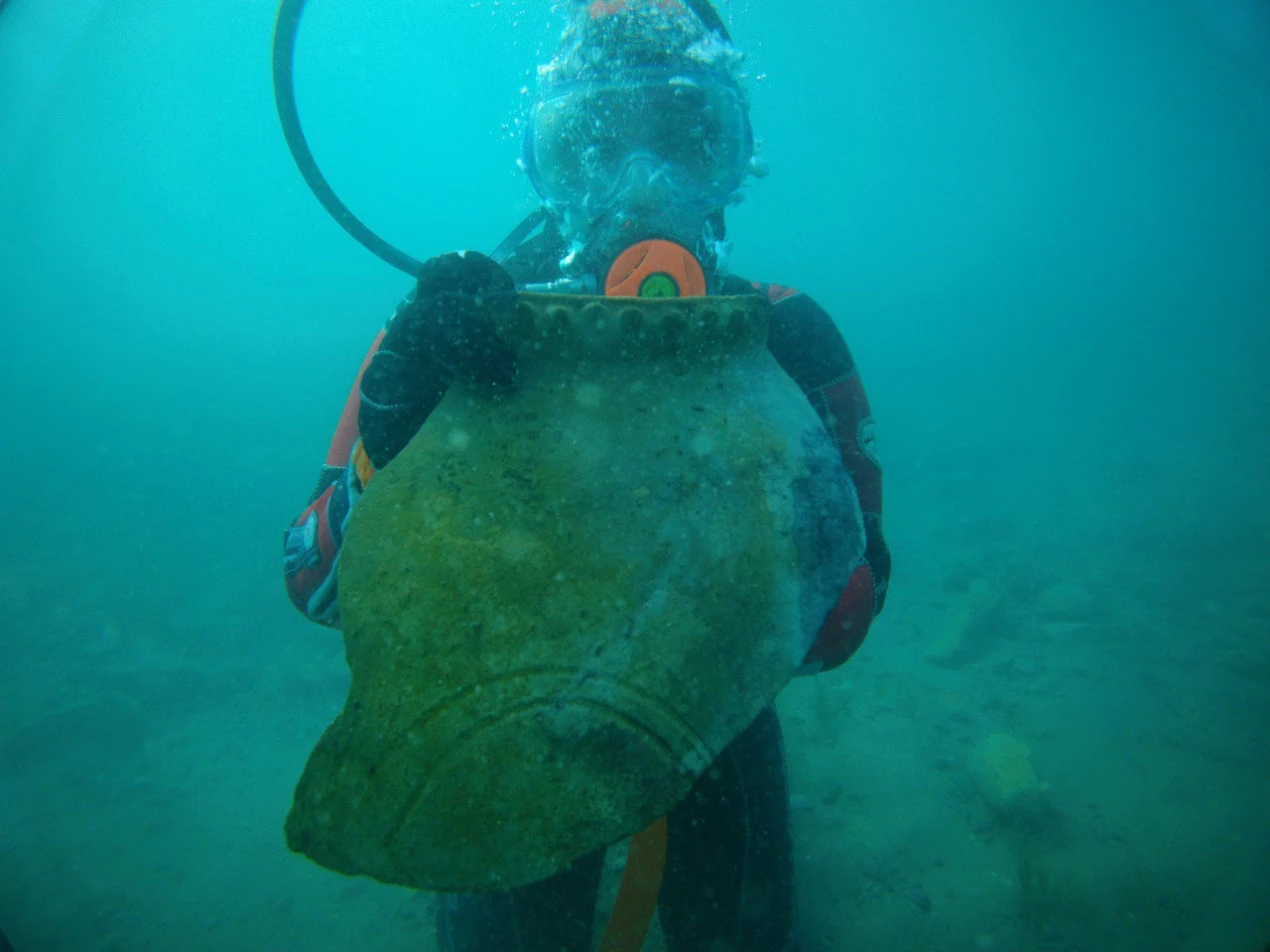
Another site uncovered fragments of medieval ceramics along with a large intact khum, a storage vessel used for holding grain, liquids, or other goods. The khum remains deeply embedded in the lakebed and will be carefully raised in the next excavation season. Nearby, the team discovered three burials, which they believe belong to an earlier cemetery. This suggests that the area was used repeatedly over different periods, indicating a complex, multi‑layered history of occupation and development.
The team also discovered mud walls and buried soils, and drilled underwater to document the remains of rounded and rectangular structures. These structures are believed to have been parts of dwellings or public buildings. These soil and structural analyses are crucial because they allow scientists to reconstruct the chronology of the city’s growth, transformation, and eventual decline before it was submerged.
Advanced underwater drones from Trionix Lab mapped the ruins in detail, creating a digital record that will help preserve the site as erosion continues.
To archaeologists, Issyk-Kul is not just a lake but a time capsule, where each artifact, whether a millstone or a skeleton, reveals echoes of trade, faith, and …[for the balance of this very intriguing article please visit: https://newatlas.com/history/submerged-ancient-necropolis/]
–
Source: Russian Geographical Society
–
Tags