








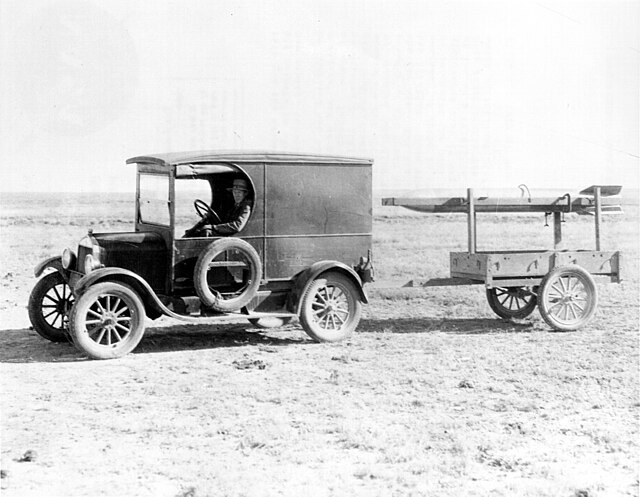
Dr. Robert H. Goddard tows his rocket to the launching tower behind a Model A Ford truck, at Mescalero Ranch, about 15 miles northwest of Roswell, New Mexico. Circa 1930-1932. Commons.Wikimedia.Org
By “AI” and Skip Whitson
2026 Mar 18
The Move to the Mescalero Ranch
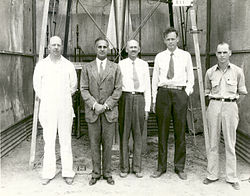
Standing in front of the rocket in the launch tower on 1935 Sep 23, are (left to right): Albert Kisk, Goddard’s brother-in-law and machinist; Harry F. Guggenheim; Dr. Robert H. Goddard; Col. Charles A. Lindbergh and N.T. Ljungquist, machinist. Commons.Wikimedia.Org
–
A Decade of Technical Breakthroughs

A close-up of Dr. Robert H. Goddard’s gyroscope and associated parts used in the stabilization of the rocket tested 1932 Apr 19, in New Mexico. Commons.Wikimedia.Org
–
- Guidance and Control: In 1932, Goddard successfully tested the first gyroscopically stabilized liquid-fueled rocket. He used a small gyroscope to detect deviations in the rocket’s path and automatically adjust moveable vanes placed in the engine’s exhaust stream to correct its course.
- –
- Supersonic Flight: By 1935, his rockets attained speeds of up to 550 mph (885 km/h), marking the first time a man-made vehicle approached the speed of sound.
- –
- Altitude Records: His rockets consistently broke altitude records for the era. In 1937, a flight reached nearly 1.7 miles (9,000 feet).

Rocket with turbopumps that inject propellants into the combustion chamber on its assembly frame is shown without its casing at the Goddard shop in Roswell, New Mexico, in 1940. With Dr. Robert Goddard (far left) is Nils Ljungquist, machinist; Albert Kisk, brother-in-law and machinist; and Charles Mansur, welder. Commons.Wikimedia.Org
–
- Fuel Delivery Systems: As his rockets grew larger, simple pressure-fed systems were no longer sufficient. Goddard developed high-speed centrifugal pumps—the precursors to modern turbopumps—to deliver gasoline and liquid oxygen to the combustion chamber.

This valve was made by the American rocket pioneer Dr. Robert H. Goddard (1882-1945) to protect his liquid oxygen tanks from bursting due to too much pressure caused by evaporation of the very cold liquid. The valve dates to the 1930’s when Goddard conducted his experiments at Roswell, New Mexico. Mrs. Robert H. Goddard donated this object to the Smithsonian Institution in 1959 as part of a large collection of artifacts from her husband. Commons.Wikimedia.Org
–
- Engine Cooling: To prevent combustion chambers from melting, Goddard pioneered regenerative cooling. This technique involved circulating cold liquid propellant around the outside of the engine to absorb heat before it entered the chamber for combustion.
- –
- Recovery Systems: He developed reliable parachute recovery systems, allowing his expensive, hand-built rockets to be returned to Earth relatively intact for study and reuse.
The Solitary Pioneer

–
Summary of New Mexico Milestones
| Period | Focus / Achievement | Key Technology |
|---|---|---|
| 1930 | Established Mescalero Ranch site | Large-scale test facilities |
| 1932 | First gyro-controlled flight | Gyroscopes & exhaust vanes |
| 1935 | Supersonic flight attempts | Reached speeds over 550 mph |
| 1937 | Successful gimbaled steering | Pivoted motor control |
| 1941 | Peak altitude achievement | Reached ~9,000 feet |
Wartime Transition and Legacy
Today, the Roswell Museum houses the most significant collection of his New Mexico work, including a full-scale recreation of his desert workshop. His name also graces NASA’s Goddard Space Flight Center, ensuring that the “Dreamer, Tinkerer, Pioneer” of the New Mexico desert is remembered as the primary architect of the Space Age.
Would you like to explore the specific mechanical drawings of his turbopumps or learn about the Guggenheim family’s other contributions to early aviation? Just do a “Google Search”!
–
If reprinting this article please credit: “WeirdNews.Info – 2026 Mar 18”