








 E. coli uses memories of the past to inform its present behavior. –
Published: 2026 Sep 10
–
Learning is often thought to
If an organism uses information from past experiences to shape its future decisions, it is also learning.
Research from my lab, published in the journal PRX Life, shows that even a single bacterium can learn from experience, store memories of the past and use those memories to prepare for the future.
Keeping track of nutrients
Bacteria live in environments that change constantly and on many different timescales. In the human gut, for example, nutrient levels go up and down, temperatures shift and antibiotic threats come and go.
To survive, a bacterium has to respond quickly to what is happening right now while still preserving useful information about what it recently experienced. Adapting too quickly leaves the bacterium vulnerable to changing conditions, while forgetting too readily makes it unable to anticipate a recurring threat.
How does a bacterium manage this balancing act? This question interested me as a computational biophysicist who studies how living systems process information and adapt to changing environments.
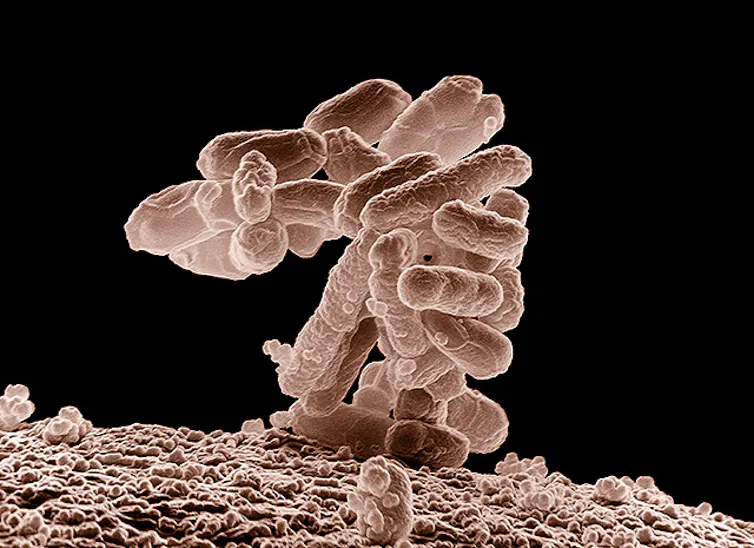
To investigate whether single-celled organisms such as bacteria can learn from past experience, my colleagues and I used what’s called a microfluidic device to track the behavior of tens of thousands of individual E. coli cells as we switched their nutrient supply on and off at different rates.
–
We found that bacteria not only react to current nutrient levels in their environment, they also keep track of their nutrient history to cope with changing conditions.
If the bacteria were simply reacting to their present environment, they would respond to a sudden pulse of food in exactly the same way, regardless of whether their previous environment was stable or rapidly fluctuating. Instead, when exposed to the same influx of nutrients, bacteria that had just experienced a feast-and-famine environment adapted much faster than bacteria coming from a stable environment.
Because the immediate conditions were identical for both bacteria, we reasoned that the difference in their behavior must originate from a stored internal record of their past rather than a simple reaction to their present.
In other words, the bacteria’s past experiences were shaping their present behavior – they were learning.
Where bacteria store memory
But where were these cells storing this information?
To better understand how bacteria were responding to changes in their nutrient environment, my team and I constructed a mathematical model of the internal molecular network that controls bacterial growth. Our model not only reproduced how bacteria behaved under different nutrient environments, but also revealed where their memory likely resides.
Our model pointed to a component of cells called ribosomes as a potential memory storage site. Ribosomes are the molecular factories of cells, building proteins and setting how fast a cell grows. Because bacterial memory revealed itself to us as changes in growth rate, our model located the source of this memory within the factories that determine growth. No other component we tested in the model reproduced this behavior.
Some ribosomes responded quickly to nutrient changes, while others changed more slowly. We reasoned that the fast responders track what’s happening in the present, while the slow responders retain traces of the past. Together, they give the cell a memory that spans many timescales, from minutes to hours.
Bacteria and AI systems
Using our mathematical model, we found that this molecular system follows the same basic computational logic as a gated recurrent neural network: a type of artificial intelligence used to process sequences such as speech and sensor data.
Key to this process is what computer scientists call a gate – that is, a molecular switch that decides how much of an existing memory to keep and how much to overwrite when new information arrives. Cells hold onto memory at a cost, because maintaining readiness to adapt comes at the expense of growth. If a bacteria is spending its energy adapting to its current environment, it has less resources to spend on growth. Bacteria use molecular gates to actively tune how much to retain and how much to discard.

Modern AI systems rely on gates to remember important details while staying flexible enough to learn something new. In the bacterium, the gate is not built from software but from the chemistry within the cell.
This strategy also helps solve a problem familiar to AI researchers: how to learn something new without erasing what was learned before. Bacterial cells balance memory and flexibility by storing information across many timescales. This kind of history-dependent computation does not require neurons. Instead, our study showed that a network of ribosome populations is sufficient.
Long before people built artificial intelligence, bacteria had already evolved a remarkably similar strategy for using the past to prepare for the future.
Using bacterial memory
Using the broadest definition of learning, our findings show that memory and learning can emerge from chemical networks in a cell, with no brain or neurons of any kind.
Our work also reveals an unexpected connection between biology and artificial intelligence. For biology, our mathematical model provides a precise, quantitative language for describing how cells process information and make decisions. For artificial intelligence, it offers a biological blueprint for building systems that can learn continuously under tight energy constraints.
These findings could also have implications for medicine. Many pathogenic bacteria survive by adapting to changing conditions inside the body. If this adaptability depends on cellular memory, then future drugs to treat infection could disrupt the molecular components that allow cells to store and use information about their environment.
–
Take a few minutes for YOU
Is Texas treating opioid addiction with psychedelics, prayer, or rodeo? Should you use a wag bag in the forest or in a shopping mall?
Fritz Holznagel here, quizmaster for The Conversation. If you like news, quizzes, or just feeling smart, come join us each Friday for our news quiz. It’s full of fun and tricky questions from The Conversation’s in-depth reporting on the issues of our times. And it’s a great way to show the world that, darn it, you really were paying attention. Can you go 8-for-8 this week?

Quizmaster and winner of the 1995 Jeopardy! Tournament of Champions
–
You might also like


Want to write?
Write an article and join a growing community of more than 232,700 academics and researchers from 5,610 institutions.
Mark Davis
AI was an attempt to replicate the process in the human brain by a computer. As such, the comparison is really between the human brain and the bacteria.
Genetic manipulation similarly duplicates what occurs in nature.
The greatest advances we have made – all of this is duplicating what already exists in life and evolution.We should be proud of our accomplishments – and awed by the complexity of life which has far more to teach us given how little we know of it.
Report
–