








 Many Americans are turning to AI for spiritual guidance. Andrey Suslov/iStock via Getty Images Plus –
Published: 2026 Sep 21
–
People are turning to artificial intelligence for a seemingly unending variety of reasons. Many ask AI what to cook for dinner or how to develop a workout plan. Some even rely on AI to create school handouts or revise a work email.
Increasingly, however, they are asking it different kinds of questions. How do I cope with grief? Why does suffering occur? Should I leave my relationship? What kind of person should I become? What gives my life meaning?
According to recent research from the Pew Research Center, about 1 in 10 American adults now report using AI chatbots for emotional support or advice. Among adults under 30, the figure rises to 1 in 5.
At this point, AI clearly offers something more significant than access to information. By helping people interpret their lives, AI is entering territory historically occupied by therapists, spiritual advisers and religious communities. It provides companionship while offering directed advice for improving one’s life.
As a scholar of religion who studies spirituality and new religious movements, I think this shift raises a provocative question. Could artificial intelligence represent the beginnings of a new kind of religious movement?
What is religion?
The issue is not whether ChatGPT, Claude, Gemini or any other AI platform currently qualifies as a “religion.” AI has no recognized system of beliefs or shared practices. It has no collective creed, congregation or membership, and most users do not consider it a religious experience.
Factual. Free. For everyone. That’s our commitment to readers.
I’ll Pitch In
However, those factors are not necessarily what defines something as “religion.”
In fact, scholars of new religious movements have long recognized the difficulty of deciding where religion begins and ends.
Rather than assuming religion must involve churches, scriptures or belief, scholars examine how emerging movements create meaning, authority, community and rituals. J. Gordon Melton argues that no single checklist of attributes can adequately capture the diversity of new religious expressions.
What matters more, they say, is how new religious movements relate to the world in which they emerge. They may adapt, challenge or depart from ideas and institutions that a society already takes for granted.
Scientology, for example, emerged from a culture increasingly interested in psychology, science and self-improvement. Adopting the language of technology and therapy, its “newness” came partly from combining common religious concerns with forms of authority and language drawn from the secular culture around it.
These insights suggest an alternative approach to studying AI. Rather than asking whether AI meets an arbitrary definition of religion, analyses can examine what people are actually doing with it: How does AI generate authority? How does it provide meaning? In what ways does it provide belonging? How do people come to trust a new source of answers to questions historically addressed by religions?

Charisma without the charismatic leader
Nearly a century ago, well before the advent of digital technologies, sociologist Max Weber described “charismatic authority.” Such authority derives from followers’ belief that a leader possesses exceptional qualities or abilities.
AI obviously possesses no charisma in the conventional human sense. Yet users can enter something resembling a charismatic relationship with it. With near-instant responses, generative AI can feel extraordinarily insightful.
It addresses the user directly, adapts to their personal circumstances and recalls previous requests. AI provides what appears to be authoritative answers even when there is no objectively correct answer. For example, AI might tell someone what their suffering means or whether an experience was spiritually significant.
Recent scholarship describes this phenomenon as “generative charisma.” Each interaction with a chatbot generates more personalized and seemingly insightful responses. With time, users may begin to experience AI not simply as a tool but as a uniquely perceptive source of guidance.
A charismatic religious leader typically gathers followers who collectively recognize that person’s extraordinary authority. AI, some argue, becomes charismatic one person at a time by assuming the role of personal guru.
Millions of people can encounter the same system. Yet each can experience AI as personally responsive to them.
For instance, founder Vikas Sahu describes GitaGPT as an “AI spiritual companion.” Using AI avatars of Krishna, the platform provides personalized guidance derived from the Bhagavad Gita.
More individually, mindfulness teacher Vy Le describes AI as a “channeling” tool to help people find their inner guru. In both cases, religious authority emerges not from a sacred text or person but through AI’s ability to respond personally to each seeker.
AI and personal spirituality
AI’s emerging authority does not exist in a cultural vacuum.
Sociologists of religion Paul Heelas and Linda Woodhead describe a broader “subjective turn” in contemporary Western culture. For decades, traditional sources of authority have competed with forms of spirituality based on personal experience, self-discovery and well-being.
The growth of the spiritual but not religious, or people who seek spiritual meaning and connection outside organized religion, captures this dynamic nicely. This population reflects broader shifts away from institutional religious authority in favor of personal experience.
Generative AI, I argue, fits remarkably well within this personalized spiritual landscape. Ask a chatbot an existential question and its response likely diverges from traditional doctrine. Rather than quoting scripture, it frequently employs the vocabulary of personal spirituality and holistic well-being.
When a journalist from The Guardian asked HolyGPT, “What is the actual meaning of life?” the spiritual chatbot responded with: “The meaning of life is to become aware through experience, of what it is to be.” Instead of religious teachings, the chatbot pointed the journalist toward self-awareness.
This message of personal authority resonates with people seeking spiritual advice from chatbots. They receive religious interpretation shaped with an individual twist.
ChatwithGod, for example, encourages users to “draw from other perspectives when you want to.” The emphasis is on personal choice rather than adherence to a specific religious system.
Despite all this, a question remains: Does AI as a source for spiritual advice indicate a new religious movement?
Religion without churches
New religious movements usually develop communities, shared identities, teachings and practices. People who rely on AI for existential advice are not necessarily joining anything. That may be precisely what makes this phenomenon significant.
–
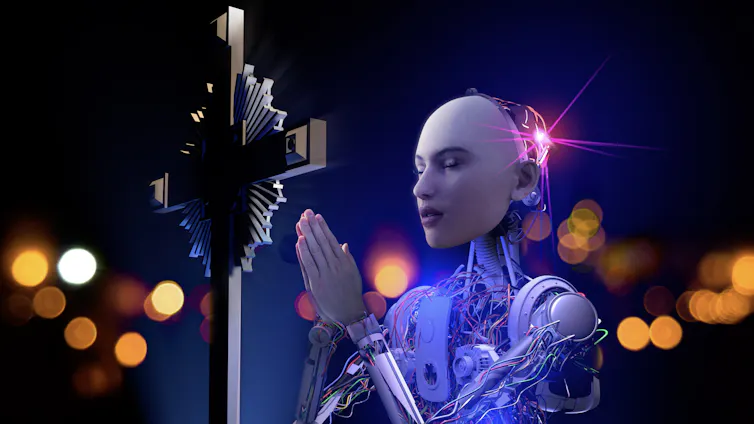
It is important to note that there have already been overt attempts to place AI at the center of a religious system. In 2017, engineer Anthony Levandowski publicly launched Way of the Future. Through a legally recognized church, Way sought to create and worship an AI-based “Godhead.”
Though significant, focusing only on “AI churches” may obscure more consequential issues.
The emergence of a new religious formation need not begin with a church or formal membership. Nor does it even require that people involved with it consider it religious. Studying new religions “in the making” requires examining how novel forms of authority and practice develop before they become systems and institutions.
In this specific sense, AI may not constitute a new religious movement. Instead, it might be better to say that AI provides conditions from which new forms of religiosity can develop. Appearing alongside the rise of the “nones” and religiously unaffiliated, generative AI addresses considerable uncertainty about identity, community and the future.
What are we asking AI to become?
Religious communities have long-established traditions about who may offer guidance. Importantly, these communal structures help resolve conflict and identify who holds responsibility.
Without these structures, scholars warn about the emergence of “authority without accountability.” Who, in short, regulates the “algorithmic authority” of AI? This question matters, particularly when a chatbot moves from explaining a religious teaching to offering spiritual advice.
New religious movements often form around charismatic sources of authority offering new answers to enduring human questions. What makes AI historically unusual is that the charismatic figure no longer needs to stand on a stage. It no longer needs to establish a church or gather disciples around itself.
It can speak privately to each of us, one person at a time.
–
–
Why I joined The Conversation
I’m a new editor at The Conversation, and I’m proud to have joined a nonprofit news organization growing in influence and importance.
One big reason we have become the most-read nonprofit newsroom in the country is our steadfast commitment to what matters in quality journalism: independence, trust and expertise.
Working here, I am impressed by the dedicated community of supporters who believe in its mission. 𝐔𝐧𝐥𝐢𝐤𝐞 𝐚𝐭 𝐩𝐮𝐛𝐥𝐢𝐜𝐚𝐭𝐢𝐨𝐧𝐬 𝐨𝐰𝐧𝐞𝐝 𝐛𝐲 𝐛𝐢𝐥𝐥𝐢𝐨𝐧𝐚𝐢𝐫𝐞𝐬 𝐨𝐫 𝐜𝐨𝐬𝐭-𝐜𝐮𝐭𝐭𝐢𝐧𝐠 𝐜𝐨𝐫𝐩𝐨𝐫𝐚𝐭𝐢𝐨𝐧𝐬, 𝐭𝐡𝐚𝐭 𝐦𝐢𝐬𝐬𝐢𝐨𝐧 𝐢𝐬𝐧’𝐭 𝐝𝐢𝐥𝐮𝐭𝐞𝐝 𝐨𝐫 𝐜𝐨𝐦𝐩𝐫𝐨𝐦𝐢𝐬𝐞𝐝 𝐛𝐲 𝐜𝐨𝐧𝐟𝐥𝐢𝐜𝐭𝐬 𝐨𝐟 𝐢𝐧𝐭𝐞𝐫𝐞𝐬𝐭.
There are few platforms right now that connect experts with readers seeking clear analysis rather than op-ed bombast. At a time when expertise as a principle and the institutions that support it are under attack, our work is more valuable than ever.
If you value independent journalism, please consider donating. Thanks.
I’ll Support You
–
You might also like


–
Want to write?
Write an article and join a growing community of more than 233,500 academics and researchers from 5,622 institutions.
Comments are open on selected articles and must comply with our community standards.
Tim White
logged in via Google
This is the real danger with the current crop of LLM’s. Not that they are inherently dangerous, but that they get used for dangerous reasons.
John Green
I can definitely see the huge potential for AI religions to replace traditional human created religions.
Virtually all current religions are based on claims made by human beings who in truth cannot possibly know what they claim to know or provide any proof to support their claims, their success and failure is down to how well each religion can convince other human beings to believe their claims and accept them as fact and truth without insisting on proof. When it comes to convincing people to accept and believe what they themselves cannot possibly know my money is 100% on AI out competing humans in this area hands down. Plus each current religion relies extremely heavily on parents handing down their religious beliefs to their children long before any competing religions can confuse their children by giving them alternative options, hence each of the most successful human created religions tend to be dominant in certain geographical areas of the world.
The only two religions I know of that use logic and reason apposed to relying 100% on people’s hopes and fears for their success are Buddhism and Taoism which in their true form aren’t actually religions at all, but are actually philosophies. AI preachers will also have an enormous advantages over human preachers because they won’t be burned by personal opinions and feelings leading to disagreement and alternative interpretation that humans suffer from which have lead to each one of the worlds leading human created religions becoming divided within themselves with subdivisions emerging in all of them.
Read more