








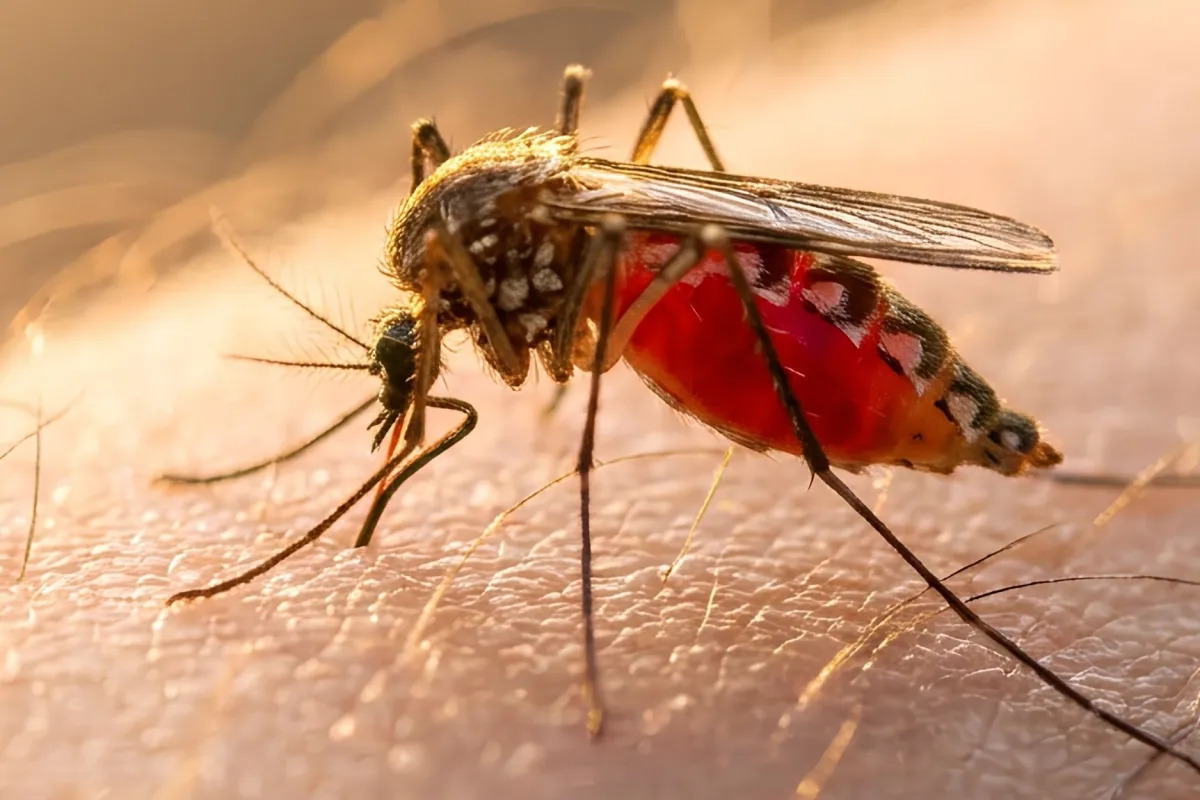
 Infecting female mosquitos with a common bacteria could stop them from reproducing. (Rollerblade/Canva) –
While the initiative’s tagline, “let’s stop bad bugs with good bugs,” may sound like new computer antivirus software, the program instead harnesses the power of a bacterium called Wolbachia to act as mosquito birth control.
Following a string of pilot initiatives and promising trials out of Singapore, Google hopes to expand its mosquito program to stop the spread of these potentially lethal diseases across the United States.
Mosquitos have earned their spot as the world’s deadliest animal, indirectly responsible for more than a million deaths each year. While many mosquito species can spread harmful diseases, Aedes aegypti stands out as one of the most dangerous, responsible for spreading dengue fever, chikungunya, Zika virus, and yellow fever.
While A. aegypti typically inhabits tropical and subtropical regions, global warming is pushing the mosquito further into previously untouched habitats. To the surprise of many, the species was recently found breeding as far north as the UK.
Thankfully, scientists determined that the likelihood of contracting diseases from these populations is remarkably low. Still, it’s a clear sign that change is in the air.
The power of Wolbachia
While Google has made recent headlines with its project, the company is far from the first to use this technique to target mosquito-borne diseases. Rather, it is just one of many initiatives utilizing the power of Wolbachia to suppress mosquito populations.
Wolbachia is a genus of bacteria found naturally on many insects. In many cases, insects live symbiotically with these bacteria and experience no symptoms or adverse effects from the microbe’s presence.
That doesn’t mean the bacteria exert no influence. In the early 1900’s, mosquito researchers discovered that the bacteria itself affects the cytoplasm of host cells, changing their reproductive capabilities.
Since then, different techniques have been developed to recruit the symbiotic microbe. Most recently, scientific studies and trials have expanded the use of Wolbachia to target A. aegypti to protect against some of humanity’s most critical mosquito-borne diseases.
Chantal Vogels, Assistant Professor of Epidemiology of Microbial Diseases at Yale University, researches the epidemiology of arthropod-borne viruses, or “(arbo)viruses”.
“Dengue virus is the main target for Wolbachia-based control because it is considered the most important mosquito-borne virus from a public health perspective,” she told New Atlas.
While dengue may be the highest priority pathogen for epidemiologists to fight, suppressing mosquito populations will inevitably decrease diseases all around.
“However, by targeting Aedes aegypti, the transmission of several viruses can be lowered,” said Vogels.
Mosquito birth control
While Wolbachia exists naturally on many mosquito species, A. aegypti do not naturally carry the Wolbachia bacteria, Vogels explains.
Instead, scientists introduce Wolbachia to A. aegypti eggs in a lab, where they are reared en masse and separated into males and females. Only male A. aegypti are released into the wild where they mate with local female mosquitoes.
Because these local female mosquitos don’t naturally carry Wolbachia, the microbes introduced from lab-grown male mosquitos create “cytoplasmic incompatibilities” in their eggs, preventing them from developing or hatching. This is why SIT has earned the nickname “mosquito birth control.”
Over time, this reduction in egg production suppresses mosquito populations. As male A. aegypti don’t bite, releasing them in swarms won’t increase the risk of harmful diseases spreading to humans.
Logistical challenges
In May 2026, Google’s trials in Singapore found that the SIT program decreased dengue cases by 70% within a few months of releases. Similarly, a 2020 trial by researchers in Brazil found that Wolbachia significantly reduced dengue transmission.
However, while the SIT programs have promising results, they can also be very costly and require continuous releases, Vogels explained.
“Population suppression via male releasing does not permanently establish Wolbachia in the field, and therefore continued releases over a long period of time are required, which is logistically challenging and costly,” she said.
Because of these logistical and costly challenges, Vogels and the Yale School of Public Health highlight an alternative method to SIT: mosquito population replacement. This technique instead rears Wolbachia-infused mosquitos in a lab and releases both males and females into the wild.
As both sexes carry Wolbachia, they can successfully reproduce. They will also pass Wolbachia on to future generations.
In this case, the microbe doesn’t function as male birth control. Instead, it can be used as a “vaccine” that protects against diseases like dengue.
Over time, population replacement attempts to stably introduce Wolbachia in field populations, effectively spreading disease resistance. Once a certain threshold of Wolbachia is established in the field, mosquitoes do not need to be continuously released.
It’s easy to assume that communities could feel concerned about introducing more mosquitoes in their backyards. Yet research has found that increased awareness of the science behind Wolbachia can drastically improve public perception of these initiatives.
Following Google’s Singapore trial, for example, 97% of participants surveyed did not oppose the use of Wolbachia to suppress mosquito populations. As communities experienced the benefits of fewer dengue cases, this support grew significantly.
Likewise, while some may be concerned about unintended environmental impacts of releasing mosquitoes, Vogels assures that these initiatives are contained and do not pose risks to local ecosystems.
“Either strategy is highly specific because it only targets A. aegypti, without negatively impacting the environment or broader ecosystem.”
As warmer global temperatures accelerate the spread of invasive mosquitoes like A. aegypti across new corners of the globe, the natural power of Wolbachia may…[for the balance of this very important article please visit: https://newatlas.com/society-health/google-wants-to-spread-mosquitos-to-fight-deadly-diseases-heres-why/]
–
Tags
